 Application Development
 Content Management
Zope automatically provides useful objects for web site builders. These include Documents, Images, Folders, UserFolders, and MailHost objects. A content manager can use these objects to create a highly interactive, yet maintainable web site. Content managers can take advantage of Zope\'s powerful object model and data sharing abilities to reduce redundant work and delegate responsibility for content.
Most web sites try to maintain a consistent style, such as common HTML menus or feedback links. Using Zope, a content manager can define a Document that renders the HTML menu in one Folder - and simply refer to that from other Documents in the system. When the menu needs to be changed, it can be changed once and the changes will instantly be visible throughout the site.
Documents also give content managers access to HTTP request variables, cookies, programmatic control of the object system and more. A content manager could create a Document that renders itself completely differently based on the browser, identity or even the remote network address of the viewer. Using the built-in Zope MailHost object, one could even arrange for a Document to send out an email anytime it is viewed!
Zope Documents provide a powerful system for dynamic content delivery. Documents add rich programming to HTML, including iterations, conditional testing, variable insertion, access to HTTP headers, cookies, and more. Since these rich HTML templates are objects, your users can undo mistakes, work on Documents in private Sessions, and take advantage of Zope's built-in security. These rich programming additions are known as the Document Template Markup Language (DTML), a server-side-include style syntax.
Database Integration
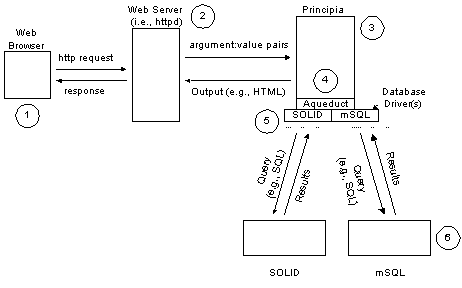
Aqueduct can also be implemented in a
multi-database architecture. What if
your sales data was kept in Oracle® on
sales.plutonia.com and your human resources data
was kept in a Sybase® database on hr.plutonia.com.
All this and your web server of choice is
Apache on Linux! Sound like an impossible
situation!? Not with Zope and Aqueduct.
Consider the following
diagram which implements this very architecture.
 Web to Objects